What it does
The robot is built to autonomously navigate public spaces to keep them clean without requiring manual human labor. It will use a combination of AI models to accurately identify and collect various types of litter from the environment
Your inspiration
It started with a simple thought: rivers are drowning in plastic, people clean them up by hand, slowly and at real risk, and we figured there had to be a smarter way. The other half was pure curiosity, because teaching a robot to drive itself and skillfully grab litter in messy, unstructured terrain is one of the hardest problems in robotics today, and that's exactly what drove us. So we combined it all into one system: a drone scouts for trash from above, and a ground robot rolls up to it and picks it up. We really believe this can clean up the world, and our main goal is to make it reliable and repeatable with cutting edge tech.
How it works
The system is two robots working as a team. A drone flies over the riverbank and scans the ground with a camera, and software trained to recognise litter finds each piece and sends its location to the ground robot. That robot is a wheeled rover that drives itself to the spot, steering around obstacles on its own. It uses a depth camera and lidar, so instead of a flat picture it knows how far away the trash is and where it sits in space. A robotic arm then reaches out and picks it up. The clever part is that the robot watches the object as the arm moves and corrects itself in real time so it does not miss, then checks the grab worked. All the thinking happens on a small computer carried on the robot, with no internet needed, which is what lets it work out in the field reliably.
Design process
We built it in three stages, each one closer to the real world.
First prototype: a cheap mobile base and a basic camera. We got it navigating toward a detected object, an apple in our tests, with a simple PI controller. Rough, but it proved the core see, decide, drive loop. (video-https://photos.app.goo.gl/XkUB3zpAazvcZTjE8)
Then we scaled up: a sturdier base and much smarter navigation, with a Kalman filter for tracking and the Nav2 stack for planning. In parallel we tackled the hard part, arm manipulation, and got it grasping and sorting reliably in the lab. The limit was hardware. To go further we need a stronger arm we do not own yet, but what we have already works dependably indoors. (video-https://www.youtube.com/shorts/BUelR3mRy-U)
Now we are taking it outside, shipping the whole stack onto a rugged Leo Rover (fictionlab.pl/leo-rover/) and building a segmentation model for obstacle avoidance that runs on board.
We design for the wild, not the lab, so reliability and endurance come first. That means running almost everything locally on a Jetson Orin Nano, pushing that board to its limit and keeping the whole system frugal on compute, while we keep trying new cutting edge tech at every step, we would need more powerful hardware
How it is different
What makes us different is that no one has a robot that picks up litter reliably and repeatably the way we are building it. Cleaning robots already exist, but they are basically sweepers: brushes, rollers and suction, blind machines that have no idea whether they grabbed the trash or just rolled over it. We are building something intelligent instead. Our robot spots a specific piece of litter, picks it up, and knows whether it succeeded. The hardest open problem in robotics right now is dexterous manipulation in the wild, messy outdoor scenes where no two situations are alike, and that is exactly the problem we are going after. The field also moves fast, so we stay at the cutting edge: we read the newest papers as they get published and pull in only the ideas that add real value to our system
Future plans
The next step is the wild: taking the robot out on the Leo Rover to see how it holds up in real conditions, not a lab. On the research side, we are developing a smarter, AI-driven way to control the arm so its grabs get more precise and dependable, and writing it up as a paper. We also want to add a 3D LiDAR for better sensing, though that is a plan for now since we lack the hardware. Most of all, the coming months are about testing and proving the whole system is reliable enough to trust outside.
Awards
We presented Drobage at GHOST day and ICRA 2026 - the top robotics conference, across two workshops, which we are proud of. As a small self-organized student team we ran the whole thing ourselves, which shows how invested we are.
https://www.linkedin.com/posts/viacheslav-krillyshyn_icra2026-ugcPost-7470241013870096385-KKAF/
Created by
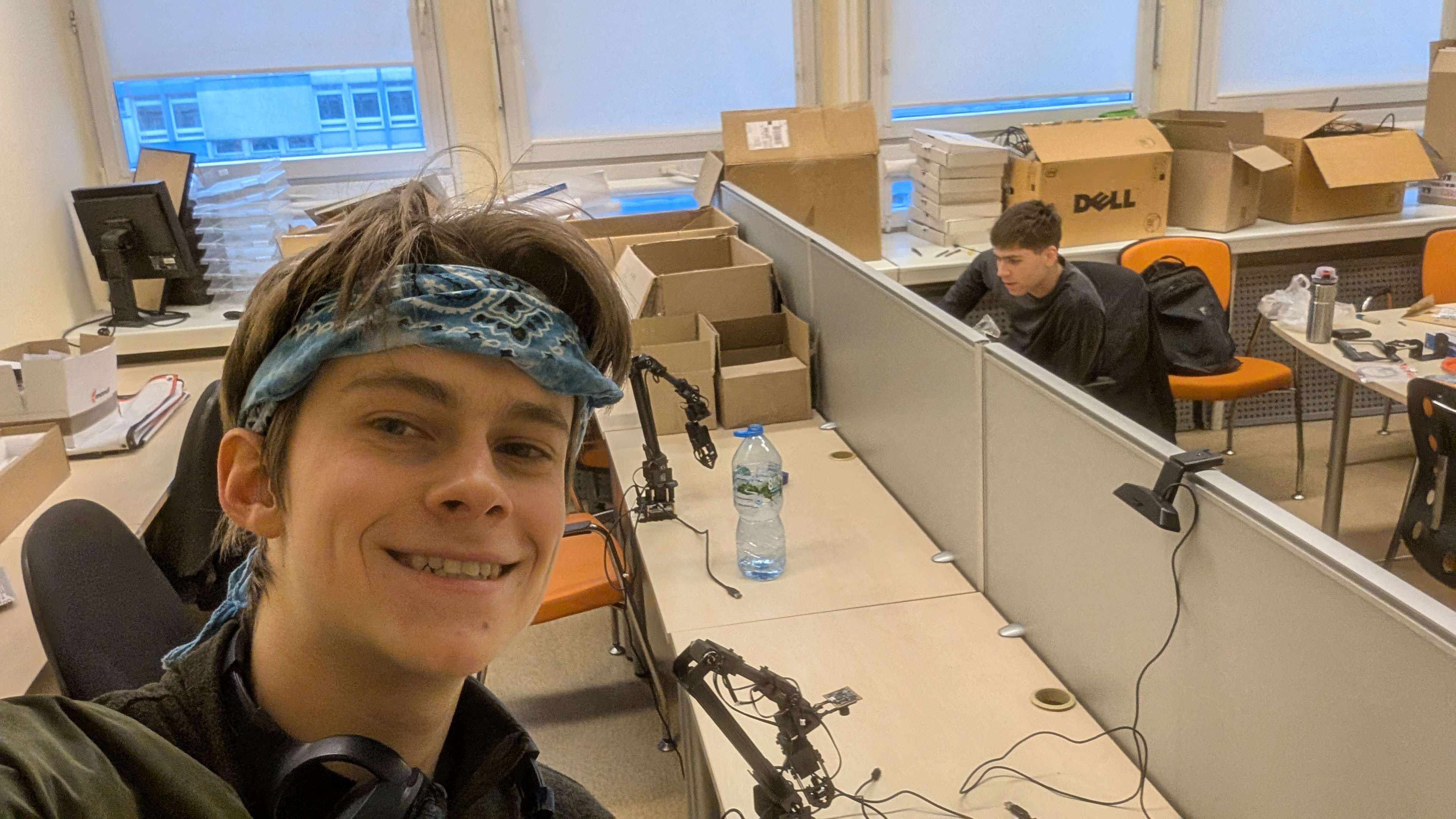
Team members
- Joanna Zubik
- Ivan Iatsenko
- Maciej Łachut
- Viacheslav Krilyshyn
University / Institution
- Politechnika Poznańska
Region
- Poland


Connect